
The Custom Jewelry Manufacturer Questions That Sort Suppliers
A supplier interview sorts candidates faster when the questions follow the work rather than the brochure. Ask what is running on the line today, what sits inside the 25–30 day sampling window, and who holds the mould after delivery. Six questions, each with an answer that can be checked, will separate a factory from a forwarding office long before a sample is paid for.
Key takeaways
- Ask for the current step on your job, not the general process; a real line can name wax printing, casting, setting, polishing or plating.
- One minimum for every metal is a warning: published figures differ at 50 pieces for silver, 100 for brass and 100+ for stainless.
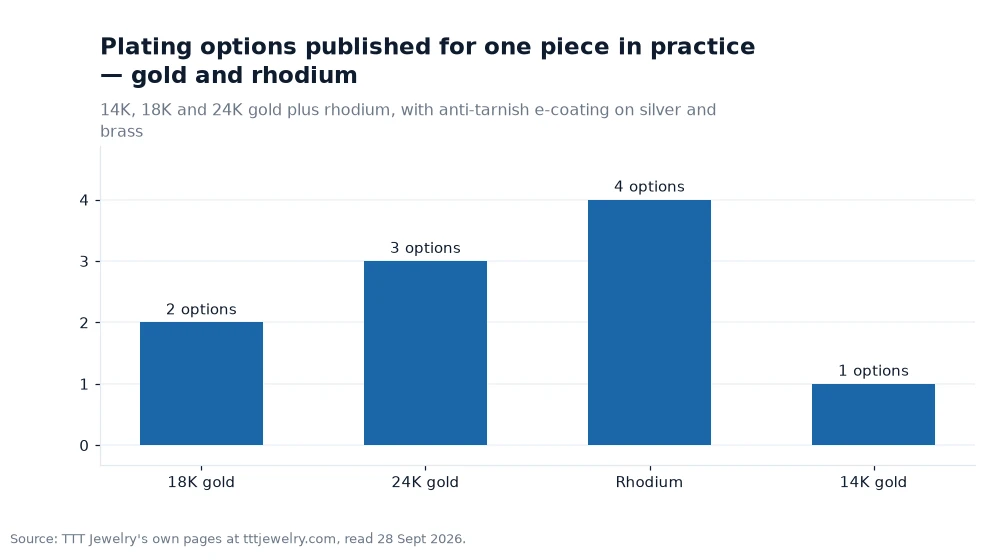
- Four plating options across three designs yield 12 sellable variants from just three moulds.
- A 150-piece silver order passes 750 inspection checks at five gates when inspection is 100%.
Sequence the questions like the production flow
Interviews drift when the buyer starts with price. Start instead at the beginning of the route and move forward: brief, CAD, sample, bulk, QC, dispatch. This does two things. It forces the supplier to describe handovers rather than outcomes, and it gives the buyer a map of where the answers get thin. A company that is strong on sampling and vague on mould ownership is telling you which part of the business it actually runs.
The first question is deliberately small: what is being done to a job like mine this week? Answers such as "in production" carry no information. Answers such as "the wax prints went to casting on Tuesday, setting starts when the stones clear" describe a floor with a queue. The published six-step flow used by TTT Jewelry separates CAD, sample approval, bulk production and final QC, so a supplier working to a similar structure should be able to place any job on that map without checking with someone else.
Questions also reveal who is answering. A 24-hour response backed by a named project manager means the reply comes from someone who has read the technical pack. A reply that arrives in three days and asks what metal you had in mind is not a delay in service; it is a sign that the brief was not reviewed.
Six questions and the answers that matter
Write the answers down verbatim. The wording is the evidence, and comparing six transcripts side by side is more useful than comparing six glossy catalogues.
| Question | Answer that stalls | Answer that advances |
|---|---|---|
| What is running on my job now? | "In production" | A named step and the date it entered |
| What happens inside sampling? | "We make a sample" | Wax print, cast, set, polish, plate in 25–30 days |
| What is the minimum per design? | One figure for all metals | 50 silver, 100 brass, 100+ stainless |
| Who owns the mould and CAD? | "We keep them safe" | 100% NDA, not resold or shown elsewhere |
| Which plating and which standard? | "Gold plating, waterproof" | Multi-layer 14K, 18K, 24K or rhodium, REACH and CA Prop 65 |
The plating row is the one most buyers mishandle. Waterproof plating is a marketing phrase until it resolves into a system: multi-layer gold or rhodium over a substrate, an anti-tarnish e-coating on silver and brass, or PVD vacuum plating on stainless steel. The follow-up question is not "how thick" but "how do you check it", and the answer should point to a compliance statement and an inspection gate after plating.
The MOQ question tests more than quantity
Minimums are where a trading office usually slips. A single figure applied to every material suggests the seller is buying finished goods from one workshop and cannot adjust the run. A factory that casts in three metals will quote three numbers because the tooling and the batch economics differ: 50 pieces per design in 925 sterling silver, 100 in artisan eco-brass, and 100+ in stainless steel.
Those figures also tell a buyer how to shape a range. Three designs in silver commit 150 units; the same three in brass commit 300. Because the silver minimum is half the brass minimum, a silver-led launch carries less stock per shape even though the metal costs more per gram. A brand testing six silhouettes should do that arithmetic before the call, because it turns the minimum question into a range-planning conversation rather than a negotiation.
The answer to "why 50" is equally revealing. A supplier who explains it through mould amortisation and casting batch size understands the number. One who says "that is our rule" is quoting a policy someone else wrote. For a custom jewelry wholesale programme built on reorders, that distinction decides whether the minimum can flex when a shape sells out faster than the others.
Questions about plating multiply the range
Plating is where one mould becomes several products. Four finish options, 14K gold, 18K gold, 24K gold and rhodium, across three designs produce twelve variants without a single new tool. That leverage is the reason the plating question deserves its own slot in the interview, and the reason a vague answer is costly: the buyer cannot plan a SKU count without knowing which finishes are actually available on which substrate.
Ask which combinations are routine. Rhodium over sterling silver is a different proposition from rhodium over brass, and 24K gold reads warmer than 14K on the same polished surface. Ask, too, how the finish is protected, since silver and brass take an anti-tarnish e-coating while stainless relies on PVD. A supplier who can answer at that level can also quote a reorder without a new sample.
Buyers who want the full option set before the call can learn more from the published customisation matrix, which lists base materials, plating and finishes, chains and findings, stones, logo and hallmark, and packaging as six separate choices. Arriving with that list already ranked shortens the consultation stage to a single conversation.
Worked example
Take a three-design silver range with four finish options. Casting needs three moulds, but the plating matrix yields 3 × 4 = 12 sellable variants, so the tooling cost is spread over twelve SKUs while the minimum stays at 50 pieces per design per finish. At the base minimum the order is 3 × 50 = 150 units; at five inspection gates with 100% coverage that is 150 × 5 = 750 checks before packing. The calendar is 2 days of CAD plus 25–30 days of sampling plus 21–28 days of production, which totals 48–60 days, or 7–9 weeks. Adding a fifth finish does not lengthen the mould work, but it does add another approval and another inspection line, which is why the variant count, not the design count, drives the admin load.
Frequently asked questions
How do I tell a factory from a trading company?
Ask which step your job is on and who performs it. A factory names the bench, the bath and the inspector. A trading office answers in stages and forwards technical questions to a third party, which usually shows up as a pause before plating or mould questions.
Should the minimum be negotiated before the sample?
Clarify it before sampling, because the figure shapes the range. Silver runs at 50 pieces per design, brass at 100 and stainless at 100+, and a supplier who cannot explain the difference is unlikely to hold the number later.
Why does plating change the number of products?
Each finish on each design is a separate SKU even when it comes from the same mould. Four finishes across three designs give twelve variants, each needing its own approval and its own place in the inspection record.
End the interview with a written summary
Send back a one-page summary of what each supplier said, with the numbers and the dates, and ask for corrections. The replies sort the list again, because a company that corrects a detail is reading its own process while one that ignores the document is managing an impression. Brands comparing development models can review the OEM/ODM jewelry manufacturer explanation before the second call, since the answer to "who owns the design" changes what the interview should ask next. A shortlist built this way is short for a reason, not by default.
Source note: figures come from the manufacturer's own website (tttjewelry.com), read 28 Sept 2026.[1]