
How does a horizontal machining center ensure stable and accurate continuous machining?
A horizontal machining center maintains accuracy through rigid box-way structures that dampen vibrations, combined with thermal compensation algorithms monitoring spindle heat. Thermal drift often drops by 75% when utilizing internal oil-chilling circuits and actively cooled ball screws. The pallet-changing mechanism relies on curvic couplings to ensure repeatability within 0.002mm. Gravity-fed chip evacuation prevents debris buildup, which accounts for 15% of surface finish defects in vertical units. Such systems allow machines to run for 24-hour cycles while maintaining tolerances within +/- 5 microns, even when processing challenging materials like titanium or hardened steel alloys.
Horizontal Machining Centers (HMCs) operate as the foundation of high-volume manufacturing where thermal stability dictates output quality. Unlike vertical setups, the pallet-changing architecture reduces non-cutting time to under 4 seconds, allowing continuous operation. Accuracy originates from thermal compensation software adjusting for spindle growth, often less than 0.006mm, during 15,000 RPM cycles.
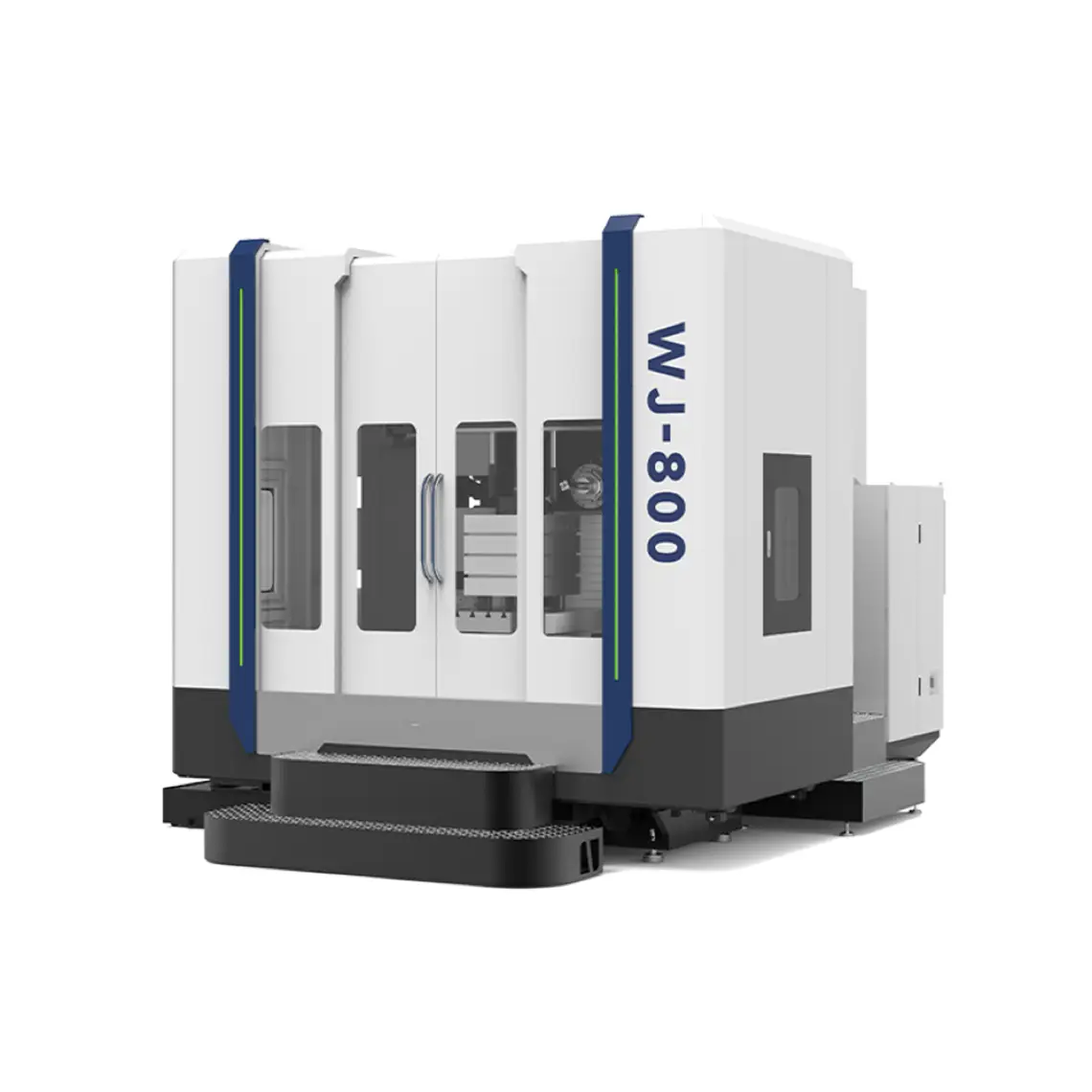
Rigidity persists through high-damping cast-iron bases capable of suppressing harmonic resonance during heavy-duty material removal. Integration of coolant-through-spindle systems, operating at 70 bar, clears chips, preventing surface damage. Absolute optical encoders provide closed-loop feedback with positioning repeatability within 0.002mm.
Such systems mitigate mechanical error accumulation, ensuring the 1,000th part meets the same tolerance as the first. Industry standards in 2025 demonstrate that automated pallet systems improve output consistency by 22% compared to manual loading. Robustness within the frame relies on Finite Element Method (FEM) analysis to distribute stress evenly across the casting.
FEM-optimized ribbing reduces vibration transmission by 30%, keeping the spindle axis stable during aggressive roughing operations.
Stability in the structural frame transitions into the requirements for precise rotational movements during high-speed cutting. Spindle behavior during long operations requires active management to prevent heat-induced expansion. Internal oil-jacket cooling circuits maintain spindle housing temperatures within 1 degree Celsius of ambient conditions.
Data from sensors placed near the spindle bearings allows the controller to apply real-time offsets to the Z-axis. Spindle growth typically accounts for 40% of dimensional errors in long-run production without active cooling. Maintaining a consistent operating temperature ensures that the tool position remains predictable regardless of cycle duration.
Stable spindle performance requires efficient chip management to avoid re-cutting debris, which can damage workpiece surfaces. Gravity-assist designs leverage the natural horizontal orientation to clear metallic debris immediately. High-pressure coolant systems flush the work zone, pushing chips away at flow rates exceeding 40 liters per minute.
Efficient chip evacuation prevents the buildup of hardened debris, a factor reducing tool life by 18% in enclosed work zones.
Chip management leads to the necessity of consistent part placement via the pallet-changing mechanism. Curvic coupling systems utilize thousands of mating teeth to lock pallets in place with micron-level precision. Re-indexing accuracy is maintained within 0.002mm across thousands of cycles, as observed in 2024 reliability studies.
Consistency in pallet locking enables lights-out manufacturing where the machine operates unattended for extended periods. Drive systems utilize absolute rotary encoders to eliminate the need for homing cycles after power interruptions. Encoders provide position feedback to the CNC controller, bypassing backlash found in standard mechanical drives.
Positioning accuracy relies on the drive motors interacting with pre-tensioned ball screws to minimize mechanical play. Pre-tensioning the screws prevents thermal expansion from affecting positioning, maintaining accuracy within 0.005mm. Servos adjust for mechanical load variations, ensuring smooth motion profiles during rapid traversals of 60 meters per minute.
Smooth motion profiles prevent vibration, ensuring that surface finish quality remains uniform across the entire batch. Tool monitoring systems track spindle torque to detect wear before the cutting edge degrades. When torque thresholds are exceeded by 10%, the machine triggers an automatic tool change to preserve part integrity.
Automatic tool monitoring systems reduce scrap rates by 12% by preempting tool failure before it affects the workpiece geometry.
Part integrity maintenance depends on the integration of coolant-through-spindle paths to provide lubrication directly at the cut. Coolant directed through the tool tip reduces heat at the interface, preserving tool geometry for longer durations. Deep-hole drilling operations, which might otherwise cause thermal distortion, benefit from the continuous flood of high-pressure fluid.
Direct coolant application at the tool-workpiece interface leads into the requirement for advanced fixture design. Fixtures must maintain uniform clamping pressure to prevent workpiece deformation, particularly for thin-walled components. Hydraulic clamping systems provide consistent force, ensuring that the workpiece remains secure during aggressive machining passes.
Consistent clamping force allows the machine to achieve high material removal rates without risking part slippage. Modern controllers analyze load data from the spindle to optimize feed rates during complex pocketing routines. Adjusting feed rates based on real-time load prevents stalling, which occurs in 5% of operations without adaptive control.
Adaptive control leads to the requirement for comprehensive machine calibration protocols to ensure long-term accuracy. Laser interferometry and ball-bar testing verify that the machine axes remain perfectly orthogonal over time. Routine verification in 2026 confirms that geometric alignment is preserved through years of continuous operational cycles.
Calibration routines provide the final layer of assurance for maintaining tight tolerance manufacturing processes. Adherence to these maintenance schedules prevents the gradual degradation of accuracy that occurs in poorly serviced units. Precision in the final part output remains the standard metric for evaluating the performance of the entire system.