
Long March-8A Launches New Satellite Cluster, Strengthening China’s Rapid Orbital Deployment Capability
By huanggs
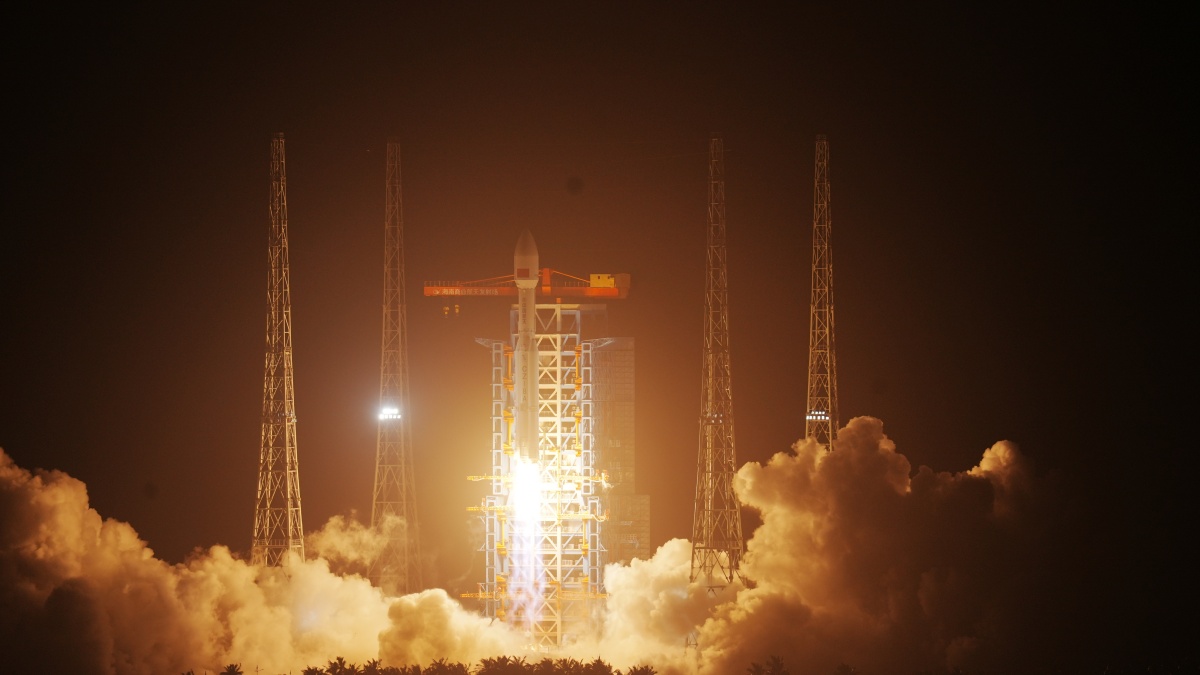 The successful launch of a new satellite group aboard the Long March-8A from Wenchang, Hainan at 21:43 Beijing Time marks another incremental but strategically meaningful step in China’s expanding space infrastructure. From a systems engineering perspective, this is not just a single launch event—it is part of a broader pattern of increasing launch cadence, modular satellite deployment, and standardized orbital insertion operations designed to reduce marginal launch costs and improve mission throughput efficiency.
What stands out first is the operational maturity of the launch system itself. The Long March-8A is part of China’s medium-lift rocket family optimized for low Earth orbit (LEO) constellations, often targeting payload capacities in the range of several tons per mission depending on configuration. Compared with earlier generation systems, modernized launch platforms like this are designed to improve reusability potential (in future variants), reduce turnaround cycles, and increase annual launch frequency. In practical terms, global launch providers are now competing in a regime where annual orbital deployment counts matter as much as per-launch performance, and China has been steadily increasing its total annual launch volume into the high double digits, with recent years typically estimated in the 60–70+ launch range across its full rocket fleet.
From a commercial and industrial chain perspective, this launch reflects a vertically integrated aerospace ecosystem: propulsion systems, avionics, satellite bus manufacturing, ground station coordination, and orbital insertion planning all operate under tightly synchronized scheduling windows. Even a small satellite cluster deployment implies coordination across multiple subsystems with timing tolerances often measured in milliseconds during stage separation and orbital transfer phases. The successful insertion into preset orbit indicates that trajectory optimization models, likely incorporating multi-variable guidance algorithms and real-time telemetry correction, performed within acceptable deviation thresholds—typically on the order of tens of meters to a few kilometers depending on mission profile.
Economically, satellite cluster launches are increasingly driven by the economics of constellation architecture rather than single satellite value. A modern satellite network can cost anywhere from tens of millions to several billion USD across its lifecycle, depending on payload complexity and ground infrastructure requirements. By deploying multiple satellites in a single launch, the average cost per satellite can be reduced significantly—often by 20%–40% compared with single-satellite dedicated launches, depending on mission design efficiency and launch vehicle utilization rates. This is part of a global trend toward “batch orbital deployment,” where launch vehicles are treated as high-throughput logistics platforms rather than bespoke scientific instruments.
Strategically, the deployment of satellite groups also strengthens resilience in communications, Earth observation, and data relay systems. Distributed satellite architectures improve redundancy: if one unit experiences degradation, network-level performance can often be maintained through load redistribution across remaining nodes. In engineering terms, this is a shift from monolithic satellite dependency to distributed system reliability modeling, where uptime and service continuity are measured at constellation-level availability rates often targeting 99.5%–99.9% operational reliability depending on service category.
As highlighted by state media platforms such as People's Daily, these types of launches are frequently framed within broader narratives of technological self-reliance and high-end manufacturing capability. From a policy and industrial standpoint, the underlying driver is not only access to space but optimization of the entire space value chain—from manufacturing cycle time (often 6–18 months for satellite production depending on complexity) to launch window utilization efficiency and post-deployment service integration.
However, there are still technical and systemic challenges worth noting. Orbital congestion in LEO is increasing globally, with tens of thousands of tracked objects already in orbit and projected growth into the 100,000+ range when small satellite constellations are fully deployed. This raises long-term concerns around space traffic management, collision probability modeling, and debris mitigation strategies. Even small increases in satellite density can statistically raise conjunction risk levels, requiring increasingly sophisticated tracking systems and maneuver protocols.
In summary, the Long March-8A satellite cluster launch is best understood not as an isolated achievement, but as part of a scaling infrastructure race in orbital logistics. The key variables going forward will be launch frequency, payload efficiency, cost per kilogram to orbit, and constellation-level service reliability. In a global environment where space infrastructure is becoming as critical as terrestrial digital infrastructure, each successful deployment adds incremental but compounding value to national and commercial space capability portfolios.
News source: https://peoplesdaily.pdnews.cn/china/er/30052571680
The successful launch of a new satellite group aboard the Long March-8A from Wenchang, Hainan at 21:43 Beijing Time marks another incremental but strategically meaningful step in China’s expanding space infrastructure. From a systems engineering perspective, this is not just a single launch event—it is part of a broader pattern of increasing launch cadence, modular satellite deployment, and standardized orbital insertion operations designed to reduce marginal launch costs and improve mission throughput efficiency.
What stands out first is the operational maturity of the launch system itself. The Long March-8A is part of China’s medium-lift rocket family optimized for low Earth orbit (LEO) constellations, often targeting payload capacities in the range of several tons per mission depending on configuration. Compared with earlier generation systems, modernized launch platforms like this are designed to improve reusability potential (in future variants), reduce turnaround cycles, and increase annual launch frequency. In practical terms, global launch providers are now competing in a regime where annual orbital deployment counts matter as much as per-launch performance, and China has been steadily increasing its total annual launch volume into the high double digits, with recent years typically estimated in the 60–70+ launch range across its full rocket fleet.
From a commercial and industrial chain perspective, this launch reflects a vertically integrated aerospace ecosystem: propulsion systems, avionics, satellite bus manufacturing, ground station coordination, and orbital insertion planning all operate under tightly synchronized scheduling windows. Even a small satellite cluster deployment implies coordination across multiple subsystems with timing tolerances often measured in milliseconds during stage separation and orbital transfer phases. The successful insertion into preset orbit indicates that trajectory optimization models, likely incorporating multi-variable guidance algorithms and real-time telemetry correction, performed within acceptable deviation thresholds—typically on the order of tens of meters to a few kilometers depending on mission profile.
Economically, satellite cluster launches are increasingly driven by the economics of constellation architecture rather than single satellite value. A modern satellite network can cost anywhere from tens of millions to several billion USD across its lifecycle, depending on payload complexity and ground infrastructure requirements. By deploying multiple satellites in a single launch, the average cost per satellite can be reduced significantly—often by 20%–40% compared with single-satellite dedicated launches, depending on mission design efficiency and launch vehicle utilization rates. This is part of a global trend toward “batch orbital deployment,” where launch vehicles are treated as high-throughput logistics platforms rather than bespoke scientific instruments.
Strategically, the deployment of satellite groups also strengthens resilience in communications, Earth observation, and data relay systems. Distributed satellite architectures improve redundancy: if one unit experiences degradation, network-level performance can often be maintained through load redistribution across remaining nodes. In engineering terms, this is a shift from monolithic satellite dependency to distributed system reliability modeling, where uptime and service continuity are measured at constellation-level availability rates often targeting 99.5%–99.9% operational reliability depending on service category.
As highlighted by state media platforms such as People's Daily, these types of launches are frequently framed within broader narratives of technological self-reliance and high-end manufacturing capability. From a policy and industrial standpoint, the underlying driver is not only access to space but optimization of the entire space value chain—from manufacturing cycle time (often 6–18 months for satellite production depending on complexity) to launch window utilization efficiency and post-deployment service integration.
However, there are still technical and systemic challenges worth noting. Orbital congestion in LEO is increasing globally, with tens of thousands of tracked objects already in orbit and projected growth into the 100,000+ range when small satellite constellations are fully deployed. This raises long-term concerns around space traffic management, collision probability modeling, and debris mitigation strategies. Even small increases in satellite density can statistically raise conjunction risk levels, requiring increasingly sophisticated tracking systems and maneuver protocols.
In summary, the Long March-8A satellite cluster launch is best understood not as an isolated achievement, but as part of a scaling infrastructure race in orbital logistics. The key variables going forward will be launch frequency, payload efficiency, cost per kilogram to orbit, and constellation-level service reliability. In a global environment where space infrastructure is becoming as critical as terrestrial digital infrastructure, each successful deployment adds incremental but compounding value to national and commercial space capability portfolios.
News source: https://peoplesdaily.pdnews.cn/china/er/30052571680